
Categories: Short Stories · Writing & Literature · Lessons from Life Experiences · Lifestyle

Grief is not only for the dead. Sometimes we lose people who are still very much alive — and no one tells you that this kind of loss can trigger a wide range of emotions, from anger to loneliness, which are all valid and deserve recognition.
There is a particular kind of loss for which the world has not yet developed enough language.
It is not death. It is not a dramatic ending — no argument that slammed a door, no confrontation that at least gave you something to hold onto, some shape of a reason you could carry and examine. It is the quiet, inexplicable disappearance of someone you believed would be permanent. A friend. A close one. The kind whose voice you knew by its rhythm. Whose silence you could sit in comfortably. Who knew the specific texture of your worst days and stayed anyway.
And then, without explanation, without ceremony, closure, or even the dignity of a goodbye — they were gone.
I am writing this because I know what that loss feels like from the inside. Not once. Not twice. But enough times that the grief has become one of the defining textures of my life. I have lost friendships I believed were permanent. I have grieved for people who are still alive, still breathing, still somewhere in the world — just no longer in mine. And I want you to know that this grief is real and valid. It deserves recognition because the loss of a friendship is a profound experience that can deeply affect us.
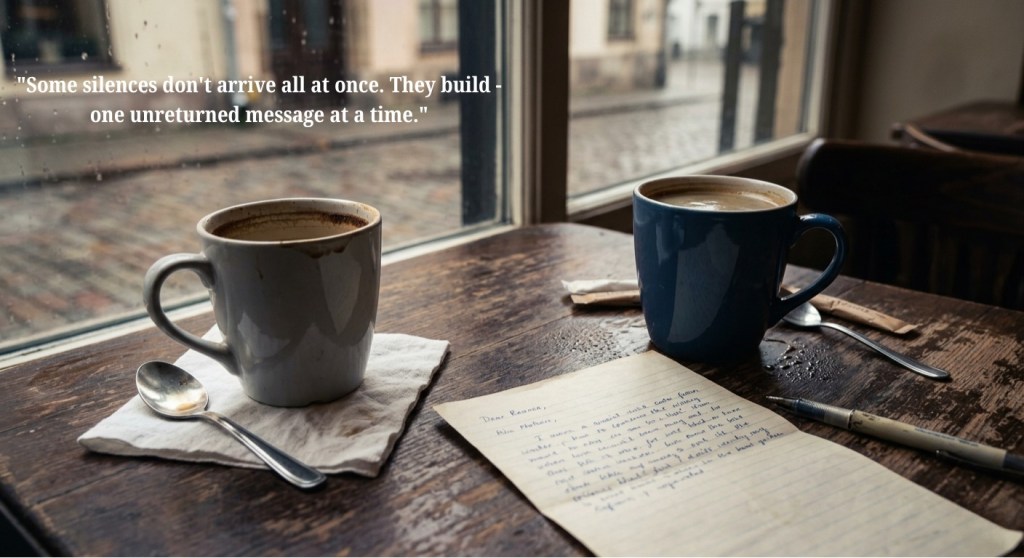
I want to start by saying I looked for reasons.
I went back through everything — every conversation, every message, every shift in tone I might have missed or misread. The way you comb through wreckage in search of the thing that caused it. I replayed the final weeks like a film, looking for clues. I found nothing that added up to an answer. I found ordinary moments — shared meals, shared laughter, the comfortable shorthand of people who have chosen each other long enough to stop explaining themselves.
I found no explanation, which is perhaps the hardest thing — not the loss itself, but the not-knowing. Without a reason, the mind invents one. And the reasons the mind invents are always, always about you, what you did wrong. What you were too much of. What you were not enough of. What flaw of yours finally became too heavy for someone else to carry? If you are feeling confused or questioning yourself, know that this is a common part of grief, not a reflection of your worth.
And sometimes, people will help your mind along. Someone will hand you a label, something neat, clinical, and damning, and tell you that this is why. That you are the problem. That the pattern of loss in your life is evidence that something fundamental is broken in who you are.
I was once told that I was a narcissist.
I want to sit with that word for a moment because I think many of you reading this have been handed a label at some point by someone leaving, someone already gone, or someone who needed to make your pain about your fault so their exit required no explanation. I took that word seriously. I did not dismiss it or defend myself right away. I went inward. I examined myself — carefully, honestly, with the kind of unflinching self-scrutiny that is neither easy nor comfortable. I asked hard questions. I listened. I sat with the discomfort of not knowing.
And what I found was this: I am not that. I am not even close. What I am is someone who feels deeply, cares deeply, and has been deeply let down and who, in the rawness of that, has sometimes been imperfect in how she carries her pain. That is not a disorder. That is being human.
But I will tell you what that accusation did, even after I had disproved it to myself. It stayed. It whispered. It made me question every relationship, every closeness, every moment of joy with another person, as if happiness itself might be evidence that I was doing something wrong. It shifted me. It made me smaller than I was. It made me work harder to make myself palatable, to soften my edges, to manage my presence in rooms so that no one could ever use that word again.
That was the real damage. Not the label. But what I did to myself in response.

Here is what I have learned about blame in the wreckage of friendship:
Sometimes you were wrong. Sometimes I was wrong. Most of the time, it was neither of us entirely, but both of us partially, a collision of two people who needed different things at the same moment and had no language to say so kindly. Blame is rarely the full story. It is usually the story that the person who left first gets to tell because they have the advantage of absence. And absence, in grief, always sounds like it must have had a reason.
People drift. People change direction. Sometimes people cannot tell you why they need space because they do not yet know themselves. Sometimes a disappearance is not about you at all; it is someone surviving their own interior storms in the only way they know how, even when that way is unkind. Even when it leaves you standing in the wreckage of something you thought was solid.
Understanding this did not make it hurt any less. I want to be honest about that. But reflecting on your feelings, journaling, or talking to someone can help you process your grief, because understanding and healing are separate but connected steps in your journey.
What I want to tell you — what I could not say at the time because the wound was too fresh for anything but silence — is this:
Those friendships were real. The love in them was real. Real things do not become unreal simply because they end. I learned from every one of those relationships. I was made more complete by knowing those people and then made more complete again by surviving their absence. Surviving is not passive. It takes a specific and underrated strength to endure and grow from the grief of losing a friend, especially when it happens repeatedly during your journey of self-discovery.
I did not merely survive it. I built something from the wreckage.
I became a published author — a writer who puts her most vulnerable self on the page and offers it to strangers, because somewhere in the grief of losing people she trusted, she found that words were the one thing that could not leave her. I became a blogger — not because everything was fine, but because the act of writing through the not-fine was itself a form of healing I wanted to share. I became a motivational speaker, standing in front of rooms full of people and saying: “You are not alone in this. Your pain has a name. Your story is worth telling.” And now I have become a publisher — someone who helps other people find and amplify their own voices. Because I know what it is to have a voice that feels fragile, to have something worth saying and not yet believe that you are allowed to say it.
All of that came from the loss, not despite it.
The broken friendships did not break me. They built me up.

I am a fighter. I am a warrior. Not the kind who never gets knocked down — the kind who gets knocked down, spends a long, honest time on the ground, then stands back up and decides that the falling will not be the last word in her story.
To anyone reading this who is carrying the weight of a friendship that ended without explanation:
You are allowed to grieve it. You are allowed to miss someone who is still alive. You are allowed to hold the unanswered question without letting it become a verdict on who you are. You are allowed to have been both right and wrong, both wounded and wounding, both the one who was left and the one who, in another version of this story, has also left.
We are rarely just one thing in these stories. And the sooner we stop needing to be the unambiguous victim to deserve our own grief, the sooner we can heal.
Some doors close without telling us why. That is one of the harder truths of being human. But a closed door is not a closed future. And the person who emerges from this particular darkness quieter, perhaps, than before, more careful, more deliberate in how she gives herself to others, more honest about what she needs, is not diminished. That person has earned something that cannot be taught.
Keep going. Keep building. Keep becoming. The friendships ahead of you — the ones that endure — are worth arriving for.
With love and the hard-won peace of someone who has been broken by this yet refused to stay broken — Lamiya Siraj.
Have you ever grieved a friendship that ended without explanation?
Leave it in the comments. This space is for that — for all the losses that don’t have a name yet, and all the words that finally do.







“Your thoughts matter – Share them below!”