
A personal essay on invisible emotional labour
Categories: Short Stories · Writing & Literature · Lessons from Life Experiences · Lifestyle
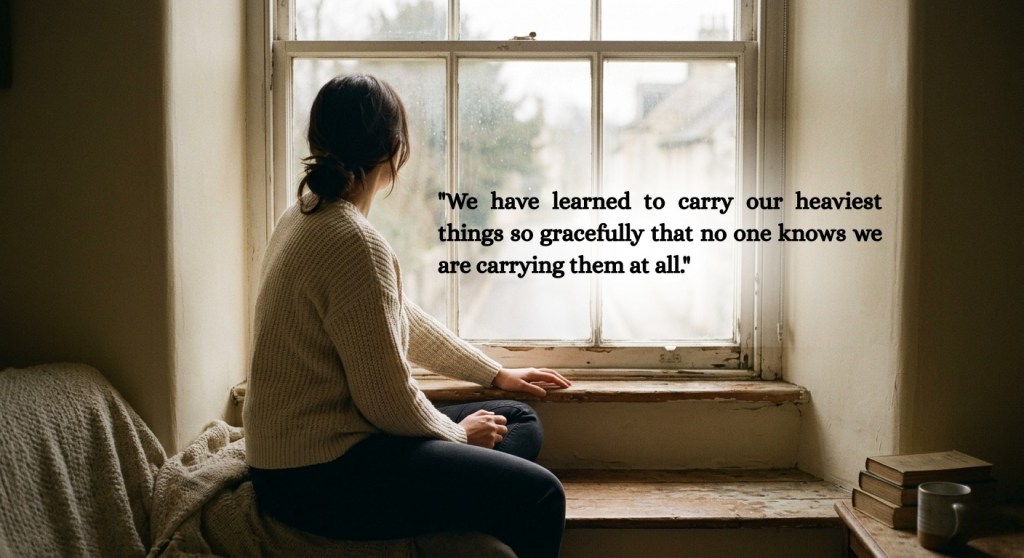
We have learned to carry our heaviest things so gracefully that no one knows we are carrying them at all.
Someone asked me recently how I was doing, and I said, “fine,” and meant it almost entirely.
Almost. That small remainder, the part that was not quite right, I folded carefully into a back pocket and carried on with the conversation. I have become very good at folding. I suspect many of you have, too.
There are things we carry lightly. Not because they are light, but because we have been carrying them long enough for our muscles to adjust. Long enough that the weight has become familiar. Long enough that we no longer notice the particular way we hold ourselves, slightly braced, slightly forward to accommodate what we are holding.
I have been thinking about this lately. About the taxonomy of invisible weight.
There is the weight of unprocessed grief.
Not just the loss of people, but the loss of versions of yourself, of lives you almost had, of doors that closed before you were ready. We are rarely given space to grieve these things because they are difficult to name. So we carry them, silently, in the part of ourselves that stays awake when everything else is quiet.
There is the weight of managing other people’s perceptions of you.
The ongoing, exhausting work of being understood correctly. Of making sure the story others tell about you is one you can live in. Of softening yourself in some rooms and expanding in others, and never quite being able to just arrive as you are and trust that it will be enough. We rarely call this what it is: labour. But it is.
There is the weight of hopes you have stopped speaking aloud.
Not because you have abandoned them, but because the gap between where you are and where you want to be has become too tender to expose. Hope that is spoken can be questioned. Hope that is silent is at least entirely yours. So we carry that too, quietly, in rooms where no one can see it and say, “But how?”

“I was afraid to call it mine. It turned out to be the work that mattered most.”
There is the weight of being seen by someone and then being looked away from.
I want to tell you something I have rarely said aloud.
When I began writing truly writing, with the kind of intention that felt like a declaration, I did not do it in a room full of encouragement. I did it alongside someone I trusted. Someone who watched how I worked, how I edited, how I submitted, how I persisted through every rejection and every quiet season of doubt. I showed them the path not as a teacher, but as a person who simply could not help sharing the things that mattered to her.
And then, one day, without a word to me, they walked that same path I had shown them to the same door I had been knocking on and opened it for themselves first.
I will not tell you it did not hurt. It did. There is a particular kind of ache that comes not from failure but from feeling unseen by someone who saw everything. The person who knows exactly how hard you worked and still does not acknowledge it is its own specific grief, and there is not yet enough language built around it.
I carried that weight too. Quietly. For longer than I would like to admit.
But here is what I learned, slowly, and only by continuing anyway: their chapter was never mine to write. And mine was never theirs to take.
I kept writing. Not because I was fearless, but because stopping felt like agreeing with a story about myself that was not true. My first book found its home. Then the second. And the work that felt most like me, the work I was most afraid to claim, turned out to be the work that mattered most.
I tell you this not to offer a tidy moral. I tell you this because I know someone reading this has recently been handed a seed of doubt by someone who should have known better. Maybe they posted first, and you posted second, and suddenly the order of things felt like a verdict. Maybe someone who shared your beginning did not share your credit. Maybe the voice in your head that says, perhaps I am not good enough, is not your own voice at all; it is borrowed, and it does not belong to you.
You were writing before that moment. You are a writer still.
The story sitting open and half-finished on your desk is waiting for you, not for someone else to restore your confidence. Confidence, I have found, does not arrive before the work. It arrives inside it.
Come back to the page. Not when you feel ready. Come back now.
There is the weight of being the one who holds things together.
For families, for friendships, for teams. The weight of being reliable. Of being the person others call. Of having made yourself so consistently available that your own unavailability has become unthinkable. This is a kind of weight that comes disguised as identity, which makes it almost impossible to put down without feeling like you are putting yourself down.
And there is, perhaps, the heaviest: the weight of knowing what you need and not allowing yourself to have it.
Rest, when rest feels like failure. Softness, when softness feels like surrender. Help: asking for help feels like an admission of inadequacy you cannot afford to make.
I am not writing this to prescribe anything. I am suspicious of essays that end with clean action steps, as if the interior life were a problem to be managed rather than a landscape to be inhabited.
I am writing this because I think there is something quietly powerful in simply naming the weight. That said, this is real. This is something I am carrying. Not as a complaint. Not as a request for rescue. Just as an acknowledgement — a moment of not pretending it is not there.
Because we are very good at pretending. At saying “fine” and meaning almost all of it. At smiling in the photograph while holding, with our other hand, something heavy and private and entirely ours.
You do not have to put it all down today. But you are allowed to stop for a moment, set it on the ground beside you, and breathe.
And if someone asks how you are doing, you are allowed to say “fine, mostly,” and let the mostly mean something.
— Lamiya Siraj
| What is the weight you have been carrying that no one knows about? You don’t have to name it fully. Even one word in the comments is enough. This space is for the things we have been too graceful about carrying alone. |







“Your thoughts matter – Share them below!”