
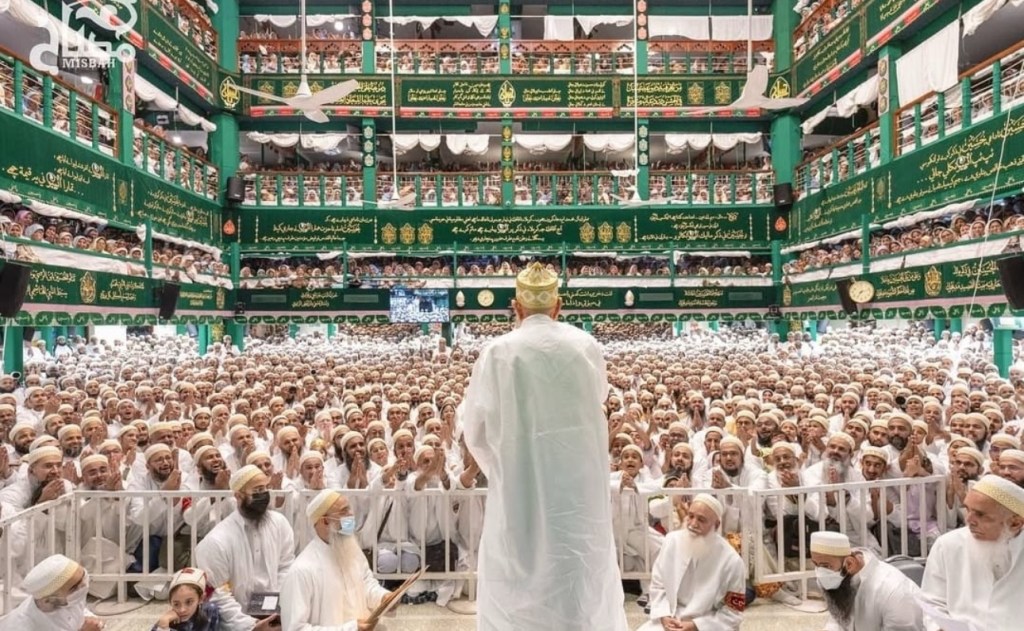
Not every city is built with bricks. Some are raised by prayers. Some are stitched together by longing. And some—like the one that rises each Muharram—are born from remembrance.
We are the Dawoodi Bohra community. And for us, Ashara Mubaraka is not an event—it is the heartbeat of our faith. It is the echo of a sacrifice that time could not silence. It is Karbala—rekindled in every soul that walks toward it.
Each year, on Eid al-Adha, the venue for Ashara is announced. And from that very moment, hearts stir with devotion. Within just 20 days, entire cities rise—not with noise or disorder, but with the quiet discipline of thousands coming together, united by the love of Imam Husain (AS) and inspired by the barakat of Huzur-e-Aala TUS’s wa’az.
Over the years, the noor of Ashara has blessed countless lands—from the historic bylanes of Mumbai and the serene courtyards of Colombo, to the vibrant cities of London, Dar es Salaam, Dubai, Karachi, and beyond. This year, Madras (Chennai) prepares to welcome over 250,000 Mumineen across 25 Mouze, every soul drawn by remembrance, every heartbeat echoing with Marhaba Ya Husain.
They are not visitors, but mourners. Each one arriving not by chance—but by a pull only Husain (AS) can command. There is no race for recognition here. No lights. No stage. Only service dressed in silence, and love wrapped in discipline. Steel rises. Canopies bloom. Pathways appear. But behind it all—there are hands. Hands that hammer not for reward, but for sacred contentment. Hands that cook, clean, and carry. Hands that whisper prayers with every movement. Two meals a day. For thousands. Served with care, received with grace.
No waste. No rush. No confusion.
From procurement to preparation, distribution to clean-up, everything is managed with the same sanctity that defines the majlis. Food is cooked in vast quantities, yet with care and consistency—ensuring that every meal is not just nourishment, but ni’mat.
Volunteers at Faiz al-Mawaid al-Burhaniyah (FMB) and across Mouze serve meals with humility and husn-e-khulq. Lines are orderly, meals are portioned with thoughtfulness, and not a single grain is wasted. This is not just logistics—it is khidmat, infused with niyyat, executed with nazafat.
Cleanliness is not just maintained—it is celebrated. Plates are returned spotless, eating areas are continuously cleaned, and biodegradable practices are followed wherever possible. Ashara becomes a living example of “Cleanliness is part of Imaan.”
This isn’t just logistics—it’s a lesson in unity, in intention, in nazafat and niyyat. Every surface shines—not just from polish, but from purpose. Every plate returned is spotless—not out of rule, but reverence. This is where discipline becomes devotion, and order becomes offering.
In Ashara, feeding over more than two lakh people twice a day is no ordinary task. But it is done with such precision, planning, and grace that it becomes a lesson in divine discipline. And then there is the feeling. That stillness. That air thick with something unseen. And amidst it all, something intangible but deeply felt takes over the air—Obhat.
Obhat is the spiritual aura that radiates from spaces saturated with love, remembrance, and sacrifice. It is what settles into the masjid long after a majlis ends. What trembles through a room filled with mourning and transforms it into strength. Obhat is not seen—it is sensed. It is the sacred vibration that lives in the silence of the volunteers, the discipline of the khidmatguzars, and the tears of the mourners. It is the heartbeat of Ashara.
It cannot be explained. Only felt. In the way your chest tightens during marsiya. In the hush that falls before matam. In the tears that fall—not from the eyes, but from the soul. Obhat is what turns ordinary ground into sacred space. It’s the breath of Karbala in a modern city. It’s what makes you forget where you are—and remember who you are.
Ashara is not a moment in time. It is a return. A return to Husain. A return to the grief that purifies. A return to the promise that love, even in loss, can move mountains. We come together not to display—but to dissolve. Not to showcase—but to serve. Not to speak—but to weep. And every whisper, every tear, every silent act of khidmat says only one thing:
“Labaik Ya Husain. Labaik Ya Dai al-Husain.”
Here, tears are not signs of sorrow alone—they are healing. They are our strength. In remembering the thirst of a child in Karbala, we quench the thirst of our ruh. In mourning the sacrifice of Husain, we rediscover our purpose. This is not just an event. This is Karbala reborn in every heart. This is not just a congregation. This is a divine calling. This is our miracle. Not built with budgets. But with barakat. Not fueled by fame. But by faith. And long after the canopies are folded and the pathways cleared, Ashara will remain. In our sajda. In our service. In our Obhat.






 Lamiya Siraj: Stories & Beyond
“Your thoughts matter – Share them below!”